
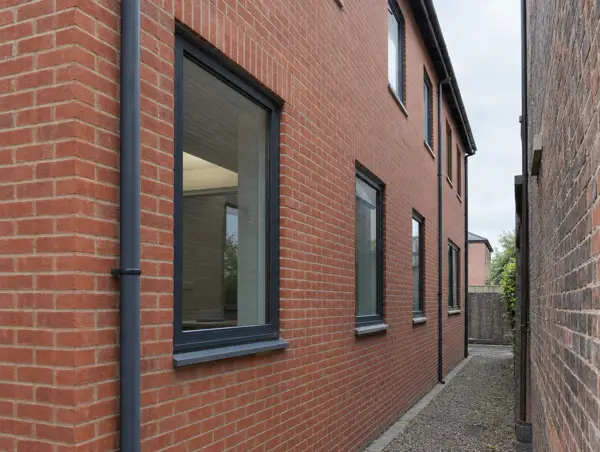
E 30 – EI 60
Fire-Rated Windows
Windows near boundaries and protected routes, tested for fire.
Learn more →Unprotected areas and external fire spread.
External walls close to a site boundary may need to be fire-resisting to stop fire spreading to neighbouring buildings. Building guidance limits the amount of unprotected area, such as ordinary windows, based on distance to the boundary. Fixed glazing that meets the wall's full fire-resistance requirement, including insulation where that is required, is not counted as unprotected area, so it can let you keep glass in those walls.
The closer the wall is to the boundary, the smaller the unprotected area allowed. Very close walls may need to be almost entirely fire-resisting.
Only non-opening glazing that achieves the wall's full fire-resistance requirement stops counting as unprotected area. Where insulation is required, integrity-only (E) glazing generally still counts as unprotected, so EI glazing is usually needed. Check the calculation with your designer or building control.
Boundary issues often arise when extending towards a boundary or converting a building. Raise them early with your designer.
Updated 09/10/2026. General guidance only; your fire strategy, designer and building control body decide what applies to a specific building.
Windows near boundaries and protected routes, tested for fire.
Learn more →
Facade glazing tested for fire where boundaries or compartments demand it.
Learn more →
E and EW glass where flames and hot gases must be stopped.
Learn more →Send sizes, photos of any glass marks or your inspection report and we will come back with the right tested system.